A WDI report is documentation, not treatment. That distinction matters when you are three weeks from closing on a house off Atlee Station Road and the lender's checklist says "termite letter." The inspection tells you…
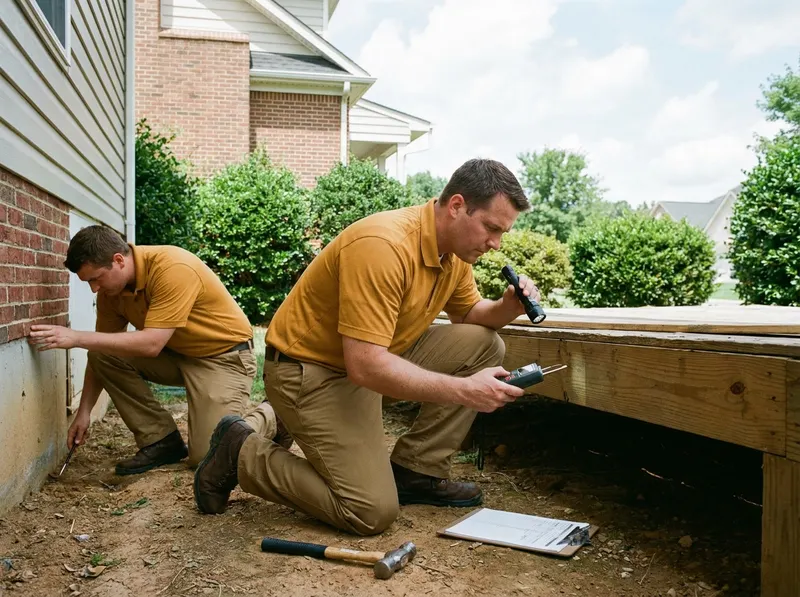
A WDI report is documentation, not treatment. That distinction matters when you are three weeks from closing on a house off Atlee Station Road and the lender's checklist says "termite letter." The inspection tells you and the lender what is present and what conditions favor infestation on that date; it is not a warranty against future termites and it does not include soil treatment. If evidence turns up, the report says so plainly, and treatment is a separate decision with its own scope and price. An inspection is the right first step whenever you need paperwork, or whenever you want a baseline before spending money on treatment. Skip straight to a treatment conversation only if you already have confirmed active termites — and even then the inspection defines where the tubes are and how far they have traveled up the framing.
Mechanicsville housing stock makes crawl spaces the center of this work. Older homes around Cold Harbor, Studley and the Rural Plains / Totopotomoy Creek side of the county sit on brick or block piers with vented crawl spaces, low ground clearance, and decades of Hanover County clay holding water after a hard rain. That is where mud tubes show up first — running up a pier face, along a girder, or fanning across the sill plate. Newer subdivisions in Rutland, Bell Creek and Laurel Meadow trade that for slab-on-grade and full-depth mulch beds pushed against the brick, which hides the inspection gap and moves the entry point to the bath trap, the expansion joint or the garage door frame. Neither is worse. They just fail in different places, and a real inspection looks in the right ones.
Spring is when the phone rings for this in Mechanicsville. Eastern subterranean termites swarm on warm, humid days from roughly March into May, and the first sign is usually not a bug — it is a scatter of translucent wings on a windowsill or in a Pole Green kitchen sink. Wings on the inside of the house are worth an inspection that week. Winged insects outside near stumps and old landscape timbers may be ants; the wing shape and waist tell the difference, and part of the visit is identifying what you actually have instead of guessing. Homes in Hanover Green, Shady Grove and Cool Spring with mature oaks, shaded north walls and long-running gutter overflow tend to accumulate the conducive conditions that get flagged: mulch above the siding line, firewood stacked on soil, a crawl space vapor barrier that stops halfway.
The report notes conducive conditions even when no termites are found, because those notes are what let you fix a $40 problem — pulling mulch back four inches, redirecting a downspout, clearing a blocked crawl vent — before it becomes a structural one. Areas that cannot be reached get marked inaccessible rather than glossed over: sealed crawl spaces, low clearance under a room addition, finished basement walls, insulated ceilings. If a section is blocked, you will hear that on site and see it on the form. No annual contract is required to get an inspection or a WDI report. Call (804) 522-0123 and we will tell you the ballpark before we come, then confirm the exact figure on site.
Every job gets a firm, written price after a free on-site visit.
Tell us about your termite inspection & wdi report job in Mechanicsville and we'll send a clear, written quote — usually the same day.
 Rovixa Pest Solutions