Identify the roach before you spend a dollar, because the two problems are treated in opposite directions. A German cockroach is small, tan, about a half-inch, with two dark stripes behind the head, and it stays within…
Identify the roach before you spend a dollar, because the two problems are treated in opposite directions. A German cockroach is small, tan, about a half-inch, with two dark stripes behind the head, and it stays within a few feet of food, water and warmth — behind the dishwasher, under the sink trap, inside the microwave housing, in the seam of a cabinet hinge. It arrived in something you carried in: a grocery box, a used appliance, a moving load, a suitcase. An American cockroach is one and a half to two inches, reddish-brown, and it did not come from your kitchen — it came from the crawl space, a mulch bed against the foundation, a leaf-packed downspout or a dry floor drain. Smokybrown cockroaches show up on shaded, wooded lots, and Mechanicsville has plenty of them off Pole Green Road and along the tree lines near Cold Harbor and Studley.
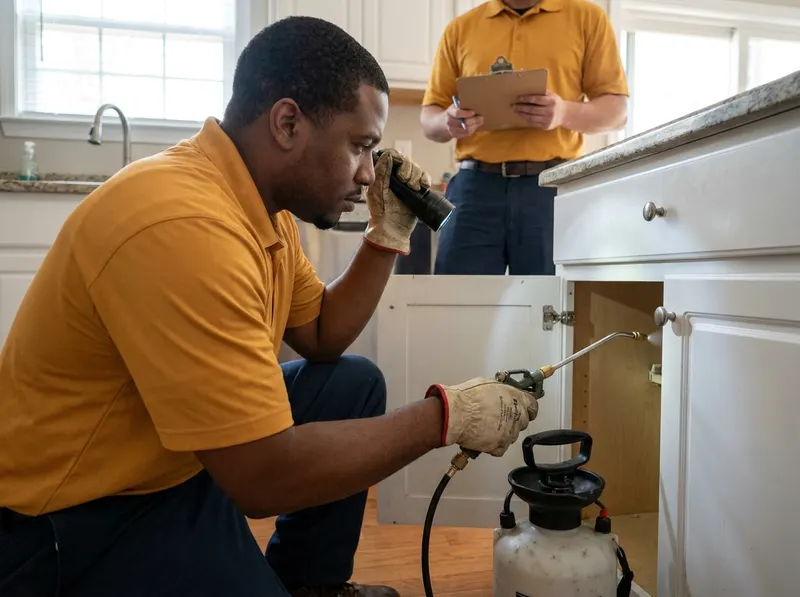
That identification decides the method. For German cockroaches we bait rather than spray the kitchen. Spraying visible roaches on a counter scatters the population deeper into wall voids and repels them away from the bait they need to eat. Gel bait goes into hinge points, drawer rails, motor compartments and the void under the sink; an insect growth regulator stops the nymphs already in the egg cases from reaching breeding age. Nothing is applied to food surfaces, and you do not have to empty every cabinet the way older whole-kitchen spray methods demanded. For American and smokybrown roaches the work moves outward — crawl space treatment, a foundation perimeter band, and the specific gaps that let a two-inch insect walk in: a torn crawl space door screen, an unsealed dryer vent, a bath trap opening, a garage threshold with daylight under it.
The trade-off is honest. Baiting is slower than a visible spray-down — you keep seeing a few roaches for a week or two while they feed and carry the bait back — but it reaches the ones inside the wall, which a surface spray never does. If you want the population gone rather than hidden, baiting wins. If it is a single large American roach in the basement after a heavy rain, you likely need one exterior and crawl space visit, not a kitchen program at all, and we will say so instead of selling the bigger job.
Older Mechanicsville homes give roaches a moisture story, and that is where most repeat calls come from. Crawl spaces around Rutland, Hanover Green, Bell Creek, Atlee Station, Cool Spring, Shady Grove and Laurel Meadow commonly have a damp corner, a sweating supply line, mulch piled above the siding line, or a downspout dumping at the foundation. Roaches, and the camel crickets that live in the same conditions, follow that dampness. We inspect the crawl space on the first visit and note grade, vents and standing water in plain language, so you can see why the insects chose your house and not the neighbor's.
For pet and child safety, bait and product go into cracks, voids and equipment out of reach — not open floors or countertops. Tell us where the dog bowl, cat box or aquarium sits and where a vegetable garden runs along the foundation, and those areas are worked around. German cockroach control is quoted as a defined 2–3 visit cycle with the follow-ups planned at the start, not as an open-ended monthly subscription. Landlords and small-office managers near Bell Creek and Atlee Station get the same structure, with unit-by-unit notes if roaches are moving between adjoining walls. Call (804) 522-0123 to get on the schedule. The line pests don't cross starts at the foundation and the sink trap.
Every job gets a firm, written price after a free on-site visit.
Tell us about your cockroach treatment job in Mechanicsville and we'll send a clear, written quote — usually the same day.
 Rovixa Pest Solutions