Carpenter ants are the ant most often mistaken for a termite problem in Hanover County, and the difference decides everything about the treatment. Set one on a white paper towel: a carpenter ant has a pinched waist,…
Carpenter ants are the ant most often mistaken for a termite problem in Hanover County, and the difference decides everything about the treatment. Set one on a white paper towel: a carpenter ant has a pinched waist, elbowed antennae, and a worker body between roughly 1/4 and 1/2 inch, with spring swarmers near 3/4 inch. A subterranean termite has a straight waist, straight beaded antennae, and leaves mud tubes instead of shavings. Carpenter ants leave frass — coarse wood shavings mixed with insect body parts — and termites never do. If you are seeing frass, we treat for ants; if you are seeing mud tubes, that is a different service and we will tell you so on site.
The structural story in Mechanicsville is consistent enough to look for on purpose. Homes on wooded lots off Cold Harbor Road and out toward Studley and Cool Spring sit under mature oak and loblolly pine, and the parent colony usually lives outside in a dead limb, stump or leaf-packed gutter, sending satellite colonies indoors. Newer subdivisions like Rutland, Bell Creek and Atlee Station bring a different route: deep mulch beds against the foundation, irrigation overspray, and pine straw touching siding give workers a shaded highway to the sill plate. Crawl spaces in older Pole Green and Shady Grove homes are the third pattern — a sub-floor joist that has been damp for years under a bathroom is exactly the wood a colony wants, and the ants are the symptom of the moisture, not the cause.
Decide between a targeted nest treatment and a whole-home perimeter program based on how many active sites you have. If ants are trailing one line under a kitchen window and you can point at a single frass pile, a targeted treatment plus exterior route work is usually the right call and the cheaper one. If you are seeing large workers in two or more rooms, or swarmers on window sills in May, expect multiple satellite nests and plan on whole-home perimeter plus interior void work — spot-treating one trail there just moves the colony deeper into the wall. The trade-off is honest: targeted work costs less and can require a second visit; the fuller treatment costs more up front and covers routes you have not found yet. We will tell you which one your house needs before you agree to anything.
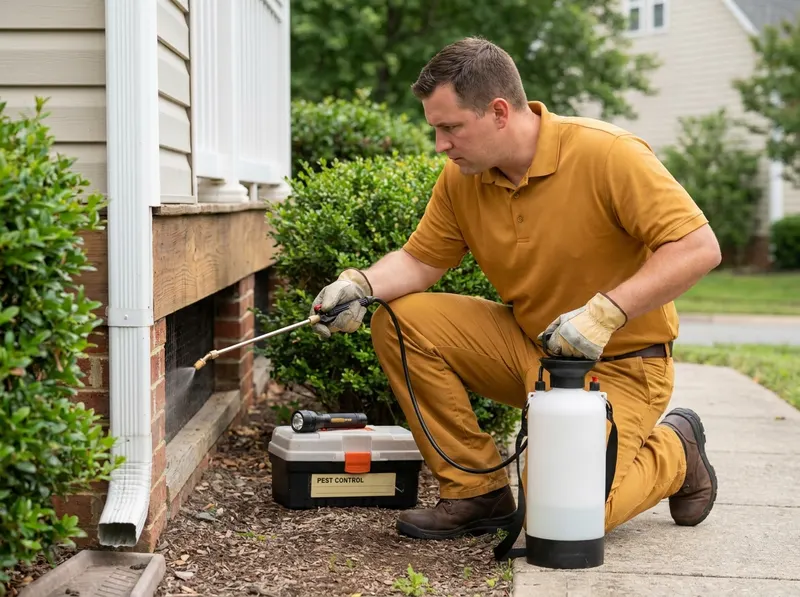
Contact-killing spray is why store-bought attempts fail on this pest. Killing foraging workers on the counter removes maybe a small fraction of the colony while the queen and brood keep producing, so the trail returns in a week or two. Carpenter ant control works through non-repellent products and baits the workers carry back to the nest, plus removal of the bridge — trimming limbs off the roof, pulling mulch back to a bare 3-inch to 6-inch gap at the foundation, moving the woodpile off the deck, and drying the source. Product choice and placement are discussed with you before application, including where dogs, children and vegetable beds are. Nothing goes in a garden bed without your say.
There is no annual contract requirement to get carpenter ants handled. Some homes on heavily wooded lots near Chickahominy Bluff and the Cold Harbor Battlefield tree line genuinely benefit from a recurring exterior cycle, because the pressure comes from the woods every spring. Many others need one treatment and a moisture fix. We will say plainly which situation you are in. Call (804) 522-0123 to get on the schedule.
Every job gets a firm, written price after a free on-site visit.
Tell us about your carpenter ant control job in Mechanicsville and we'll send a clear, written quote — usually the same day.
 Rovixa Pest Solutions