Two things tell you it is subterranean termites and not something else. First, pencil-width mud tubes running up a brick pier, a block wall, or the inside of a crawl space rim joist — scrape one open and there are…
Two things tell you it is subterranean termites and not something else. First, pencil-width mud tubes running up a brick pier, a block wall, or the inside of a crawl space rim joist — scrape one open and there are cream-colored workers inside. Second, a pile of discarded wings on a window sill or in a spider web, usually in a warm stretch between March and May, which is when swarms show up across Hanover County. Winged swarmers indoors mean a mature colony is already established under or beside the structure, not that termites just arrived. If the boards sound hollow when tapped near a crawl space access or a garage wall, that damage is the record of feeding that has been going on for a while.
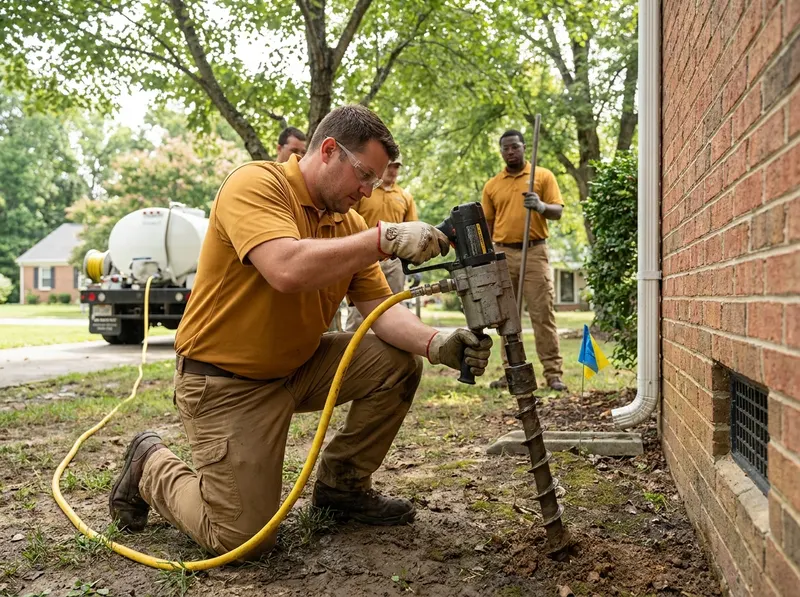
The decision most Mechanicsville homeowners face is liquid barrier versus bait system. A liquid termiticide treatment is the right call when there is active tubing, when you need the colony's access cut off now, and when the foundation can actually be trenched — a six-inch-wide, six-inch-deep trench along the outside wall, refilled with treated soil, plus drilled holes through slab porches and expansion joints at regular spacing. Label rates for most soil termiticides call for roughly four gallons of finished solution per ten linear feet per foot of depth, which is why a full perimeter takes hundreds of gallons and several hours. Bait systems fit differently: they suit homes where trenching is blocked by a poured patio, a wraparound deck, or heavy hardscape, and they suit owners who want ongoing monitoring stations checked on a schedule rather than a single large soil application. The trade-off is honest — liquid works faster on an active infestation, baits work slower but keep telling you whether termites are still foraging. Some houses get both: liquid at the active wall, stations around the rest.
Mechanicsville housing stock splits the work in half. Older homes toward Studley, Cool Spring and the Cold Harbor and Totopotomoy Creek side sit on crawl spaces with brick or block piers, and the failure points there are almost always moisture-driven: a downspout dumping at the corner, no vapor barrier, or a sill plate sitting damp all summer. Newer sections — Rutland, Bell Creek, Atlee Station, Laurel Meadow — are heavier on slab-on-grade and full-height block, where the entry points are expansion joints, plumbing penetrations, and mulch piled above the brick weep holes. Hanover County's clay-heavy soil holds water against a foundation instead of draining it, and mature hardwoods around Pole Green and Hanover Green leave stumps, buried roots and old landscape timbers in the yard that feed colonies within feet of the house.
That is why the inspection comes before the price, and why structure gets addressed alongside chemistry. We measure the linear footage of foundation, note every slab and porch that needs drilling, pull the crawl space hatch, and show you the wood-to-soil contact, the grade, and the mulch line that made the house findable in the first place. Pulling mulch back four inches, extending a downspout, and removing scrap lumber from under a deck costs nothing and takes pressure off the treatment. You get a scope sheet listing what is being treated, with what, and what the follow-up looks like. No annual contract is required to get a termite treatment quoted or performed. Ask about pet, child and vegetable garden concerns during the walkthrough — soil termiticides are applied below grade against the foundation and we will tell you plainly where product goes and what the label directs for re-entry.
Every job gets a firm, written price after a free on-site visit.
Tell us about your subterranean termite treatment job in Mechanicsville and we'll send a clear, written quote — usually the same day.
 Rovixa Pest Solutions