The mosquito problem in Mechanicsville is not one insect. Yards backing to Totopotomoy Creek near Rural Plains, the low ground along Bell Creek, and the wooded edges around Cold Harbor and Studley produce floodwater…
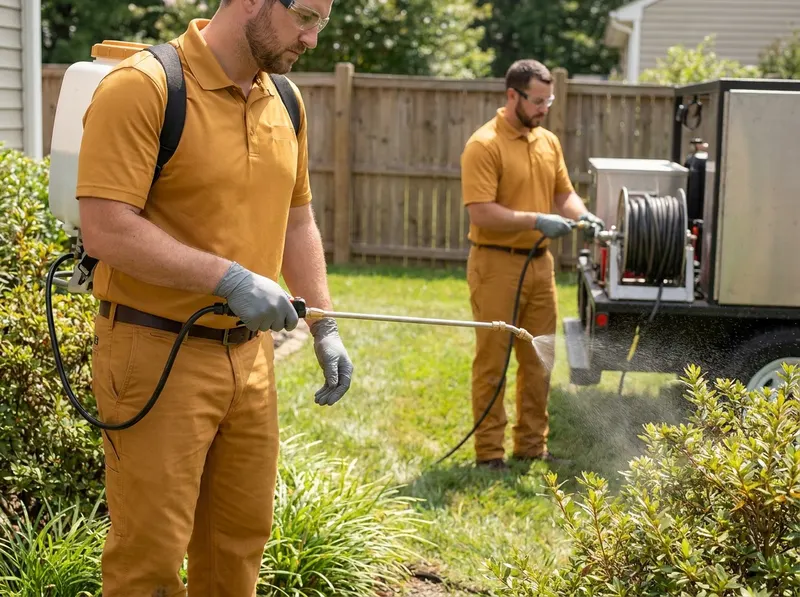
The mosquito problem in Mechanicsville is not one insect. Yards backing to Totopotomoy Creek near Rural Plains, the low ground along Bell Creek, and the wooded edges around Cold Harbor and Studley produce floodwater and tree-hole mosquitoes that push in from outside the property line. But the biters most homeowners in Rutland, Hanover Green and Laurel Meadow actually swat at 4pm are Asian tiger mosquitoes, and those are usually bred on-site. They need about a bottle cap of standing water to complete a life cycle, which is why the walk-through matters more than the spray gun. A corrugated downspout extension lying in the mulch, a saucer under a potted fern, or the folds of a grill cover will out-produce the creek.
A barrier treatment is the right fit when you want the yard usable — evening cookouts, kids in the back yard, dogs out after dinner — and you accept that it is a maintenance service, not a one-time cure. Residual product on foliage breaks down under sun, heat and Hanover County thunderstorms, so treatments are scheduled on roughly a 21-day cycle through the season. Source reduction alone (dumping containers, clearing gutters, screening rain barrels) is free and genuinely cuts the population, but it does nothing about mosquitoes flying in from a neighbor's ignored kiddie pool or the shaded ivy along a shared fence. The honest trade-off: skip the barrier and you keep the yard 30–40% less bitey with pure effort; run the barrier and you get the yard back, but on a recurring bill.
One-time treatment fits a fixed date — a graduation party, a backyard wedding, a Sunday afternoon after a Pole Green Park game. Applied 48 to 72 hours ahead, it gives you the event. It will not carry you through July. Lot conditions drive everything else: an open, sunny half-acre in Atlee Station holds less mosquito habitage than a shaded quarter-acre in Cool Spring or Shady Grove with mature oaks, deep mulch beds, an English ivy bank and a vented crawl space that stays damp. Older homes near the Cold Harbor and Gaines' Mill corridors frequently have grade that sends roof water back toward the foundation, which turns the crawl space perimeter into a permanent nursery — that gets flagged, because spraying leaves above a standing puddle is theater.
On safety, the two questions that come up every time in Mechanicsville: pets and gardens. Applications are made to foliage and structure surfaces, not lawns you sit on, and the treated areas need to dry before pets and kids return — typically well under an hour in summer heat. Vegetable gardens, herb beds and plants in bloom are not treated, and applications are timed away from peak pollinator activity to protect the bees working your holly and clover. Nothing about the schedule is locked before you see it: the walk-through comes first, the price is confirmed on the spot, and you decide then whether you want a single visit or the season. Call (804) 522-0123 and describe the yard — shaded or open, creek or no creek, acreage — and you'll get an accurate ballpark on the phone before anyone drives out.
Every job gets a firm, written price after a free on-site visit.
Tell us about your mosquito yard treatment job in Mechanicsville and we'll send a clear, written quote — usually the same day.
 Rovixa Pest Solutions