Bait and monitoring fits a specific kind of house, and Mechanicsville has plenty of them. If your foundation is wrapped in a concrete patio, a brick walk, a stamped driveway apron, or a stone bed you paid good money…
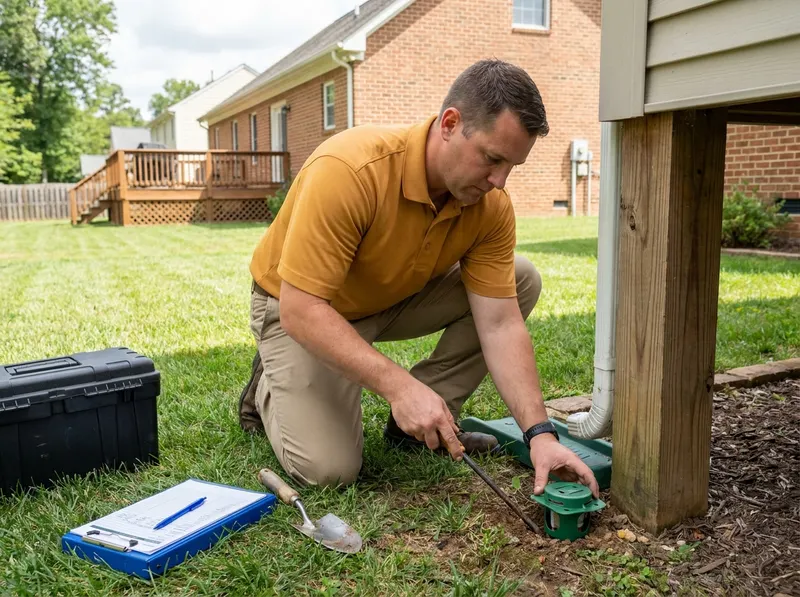
Bait and monitoring fits a specific kind of house, and Mechanicsville has plenty of them. If your foundation is wrapped in a concrete patio, a brick walk, a stamped driveway apron, or a stone bed you paid good money for, a liquid soil treatment means trenching and drilling through it. Stations go in the open soil between the hardscape instead. Bait also fits homeowners near Totopotomoy Creek, Cold Harbor, and the low wooded lots off Pole Green Road who don't want a continuous chemical zone poured next to a vegetable bed, a shallow well, or a dog run. And it fits anyone with a pending sale: a monitoring history is documentation, not a promise — a dated log of station checks shows a buyer's agent what has actually been happening in the soil.
The alternative is a liquid termiticide barrier, and it wins on speed. Liquid establishes a treated zone in the soil the same day it goes down, which matters when swarmers are already coming out of a crawl space wall in April. Bait works on the colony's timeline — termites have to find a station, recruit, and feed, and that can take weeks to months. The honest trade-off: liquid is faster to establish and often cheaper up front, bait is less invasive and keeps telling you something after the truck leaves. On homes with active damage we frequently recommend both — a targeted liquid application at the point of entry, then stations to catch whatever forages back.
What drives termite pressure here is structural, not mysterious. Older crawl-space homes around Studley, Shady Grove, and Cool Spring sit on Hanover clay that holds water long after a storm, and the mulch beds get topped up each spring until the mulch line climbs above the brick weep holes. Add a mature hardwood canopy, buried stumps, old railroad-tie edging, scrap lumber under the deck, and a downspout dumping at the corner, and you have a food source with a moisture supply. Newer slab construction in Bell Creek, Laurel Meadow, and Atlee Station gets hit differently — through expansion joints, plumbing penetrations, and the seam where a slab-on-grade addition meets the original block. Station placement follows moisture and wood, not a uniform grid. Downspout outfalls, crawl space vents, deck posts, and the shady north side get closer spacing.
Monitoring is not a formality. Stations are pulled and read on a set schedule — commonly every 2–3 months in the active spring and summer stretch, then at longer intervals through winter — and a hit changes the plan immediately. We show you the station, the wood, and the tubing rather than describing it over the phone. Around Rutland and Hanover Green we watch for swarmers on south-facing window sills from roughly late March through May, which is often the first thing a homeowner notices at all. No annual contract is required to have stations installed; monitoring is priced per year and you decide whether to renew. Call (804) 522-0123 and we'll walk the foundation with you first.
Every job gets a firm, written price after a free on-site visit.
Tell us about your termite bait & monitoring system job in Mechanicsville and we'll send a clear, written quote — usually the same day.
 Rovixa Pest Solutions